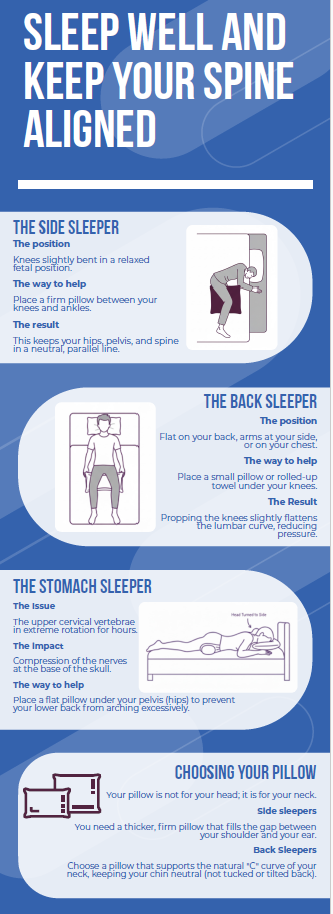
Sleep well and keep your spine aligned
We spend a third of our lives in bed, yet most of us are unknowingly putting pressure on our spines every night. If you wake up with back pain, neck stiffness, or tingling in your arms, your sleep posture is likely putting unnecessary pressure on your body.
Here are some ways to help relieve the pressure and sleep well.
1. The Side Sleeper
Most people are side sleepers, but without support, gravity pulls the top leg down, twisting the lower back (lumbar spine) and straining the sacroiliac (SI) joints.
The position
Knees slightly bent in a relaxed fetal position.
The way to help
Place a firm pillow between your knees and ankles.
The result
This keeps your hips, pelvis, and spine in a neutral, parallel line. It stops the "rotation" that causes morning sciatica and lower back aches.
2. The Back Sleeper
Sleeping on your back is excellent for weight distribution, but it can create a "hollow" in the lower back, causing the hip flexors to pull on the spine all night.
The position
Flat on your back, arms at your side, or on your chest.
The way to help
Place a small pillow or rolled-up towel under your knees.
The Result
Propping the knees slightly flattens the lumbar curve against the mattress, opening up the nerve exits (foramen) in your lower spine and reducing pressure on the facet joints.
3. The Stomach Sleeper
If you can avoid this position, do so. Stomach sleeping can cause back pain and spinal strain.
The Issue
You cannot breathe through your pillow, so you must turn your head 90° to one side. This keeps the upper cervical vertebrae (C1 and C2) in a state of extreme rotation for hours.
The impact
This "kinks" the vertebral artery and compresses the delicate nerves at the base of the skull.
The way to help
If you must sleep on your stomach, place a flat pillow under your pelvis (hips) to prevent your lower back from arching excessively, and try to use a very thin pillow (or no pillow) for your head.
4. Choosing Your Pillow
Your pillow is not for your head; it is for your neck.
Side sleepers
You need a thicker, firm pillow that fills the gap between your shoulder and your ear.
Back Sleepers
You need a contoured pillow that supports the natural "C" curve of your neck, keeping your chin neutral (not tucked or tilted back).
Note:
While these positions help maintain your alignment, they cannot fix a 'stuck' or misaligned joint. If you find that you cannot get comfortable in any position, get checked out by a professional.
gET IN TOUCH
- Mon - Fri
- -
- Saturday
- -
- Sunday
- Closed